I arrived on Fair Isle on Monday 24th September instead of the planned Saturday 22nd September due to adverse weather conditions. This adverse weather was to become a theme of the trip with this update being on Wednesday 3rd October.
Basically there was a constant and persistent westerly wing which varied from very strong to bonkers. This constant west gale force wind was not coming from anywhere near the North American landmass so American landbirds were generally going to be out of the question; though Foula yet again got a White-crowned Sparrow and a Buff-bellied Pipit.
Birding on Fair Isle was tough as there were hardly any migrants present but I still managed a Fair Isle tick in the form of a Corncrake at Quoy, god knows how that managed to get here in these conditions.
This lack of birds was a theme for the rest of Shetland and Orkney with this being one of the worst, or perhaps even 'the' worst, autumn ever. A few things obviously crept through to Shetland by Fair Isle just seemed to be devoid of birds when Shetland, Orkney and Foula all started to turn up birds.
An Ortolan Bunting, a Lapland Bunting, a few Snow Buntings, Whooper Swans and a few geese were other wise the highlights of the past 10 days, along with the previously mentioned Corncrake.
Today, 3rd October, saw light winds and slightly drifty conditions and it was a pleasant respite from the buffeting winds but despite a hell of search around the island there was no rarity found again with the best bird of the day being a long overdue Yellow-browed Warbler at Field. I was getting worried I wasn't actually going to see one this autumn, I still haven't seen a Jack Snipe yet so that ones looking dodgy for getting onto the year list this year as well.
By late afternoon there was a clear arrival of Redwings but with the now persistent rain and failing light it seemed the now late promise of good birding was brought to an end. Tomorrow we are expecting more rain and an increase in wind again from the west with Friday looking like another howler coming in across the isle.
I'll keep plugging away when the weather conditions allow but this year we are seeing the complete opposite to 2016 when we had constant flow of easterlies that brought so many great birds to the isle; to reminisce on the autumn we had: 2 Siberian Accentors, 4 Pine Buntings, 4 Red-flanked Bluetails, a 2 Lanceolated Warblers, Raddes Warbler, Dusky Warbler, Arctic Warbler, Blyths Reed Warbler, Pechora Pipit, 74+ Yellow-browed Warblers on super Sunday, 2 Siberian Stonechats, Short-toed Lark, 4 Great Grey Shrikes, Red-throated Pipit, Richards Pipit, 3 Shorelarks, 3 Olive-backed Pipits, Glaucous Gull, Red-breasted Flycatcher, Tundra Bean Geese, Paddyfield Warbler, 9+ Little Buntings, 3 Common Rosefinch and 2 Bluethroat.
Ah they were the days........
Wednesday, 3 October 2018

Saturday, 22 September 2018
26years Between Buntings
So today I couldn't get over to Fair Isle due to the high winds and just as we were about to leave Tingwall Aiport news of a Yellow-breasted Bunting appeared on the WhatsApp Rare bird news group.
Given the wind conditions, very strong North West, this bird was a bit of a surprise. Tore out of Tingwall and raced to Laxo ferry terminal and arrived just as the ferry was about to pull and as was quick of the mark was only 3 cars from the front of the queue.
A short ferry crossing later and a short drive to the site at Vats-Houll where the bird was seen tracked down to a ditch near the last house. It then went on to show pretty well over the next hour or so, though we kept a respectable distance as firstly given the very windy conditions we didn't want to cause the bird unwanted disturbance and secondly we didnt want to flush the bird as other birders would be arriving on the next ferry.
As a result this image here is the best I could get, it was realy difficult keeping the camera still in such windy conditions.
The only previous UK Yellow-breasted Bunting I have seen was way back on 1992 on the Farnes so a whopping 26 years ago.
There will be, and are, better images of this bird than mine but I'm satisfied with this streaky eastern bunting given the conditions.

Given the wind conditions, very strong North West, this bird was a bit of a surprise. Tore out of Tingwall and raced to Laxo ferry terminal and arrived just as the ferry was about to pull and as was quick of the mark was only 3 cars from the front of the queue.
A short ferry crossing later and a short drive to the site at Vats-Houll where the bird was seen tracked down to a ditch near the last house. It then went on to show pretty well over the next hour or so, though we kept a respectable distance as firstly given the very windy conditions we didn't want to cause the bird unwanted disturbance and secondly we didnt want to flush the bird as other birders would be arriving on the next ferry.
As a result this image here is the best I could get, it was realy difficult keeping the camera still in such windy conditions.
The only previous UK Yellow-breasted Bunting I have seen was way back on 1992 on the Farnes so a whopping 26 years ago.
There will be, and are, better images of this bird than mine but I'm satisfied with this streaky eastern bunting given the conditions.

Saturday, 15 September 2018
Stone Curlew - take two
So like buses Stone Curlew in SOG this year has put in another twitchable performance.
The bird that I found at Bowers marsh some weeks ago was the first in SOG for 20years, excluding flyovers heard at night, so was a bit of a surprise that we get another lingering bird, this time at Lower Raypits, Canewdon.
Almost the direct opposite of the Bowers bird this one required a long hike out from Lion Creek rather than the relatively short walk from the Bowers Marsh car park. From the hide the bird would show pretty close whereas the Bowers bird was always at the limits of camera range.
Still it was worth the walk as it did show well once I located it, took me half an hour.
Could it actually be the same bird as that at Bowers or a different bird; logic would dictate it is a second bird.


The bird that I found at Bowers marsh some weeks ago was the first in SOG for 20years, excluding flyovers heard at night, so was a bit of a surprise that we get another lingering bird, this time at Lower Raypits, Canewdon.
Almost the direct opposite of the Bowers bird this one required a long hike out from Lion Creek rather than the relatively short walk from the Bowers Marsh car park. From the hide the bird would show pretty close whereas the Bowers bird was always at the limits of camera range.
Still it was worth the walk as it did show well once I located it, took me half an hour.
Could it actually be the same bird as that at Bowers or a different bird; logic would dictate it is a second bird.


Saturday, 11 August 2018
Bowers Marsh : August 2018 part 2
With the Stone Curlew at Bowers Marsh being the main attraction oother birds were inevatibly discovered and I was now bolstered by my find and wanted to get out and see the Great White Egret and Glossy Ibis.
I had some success in this endevour with the Great White Egret finally giving itself up to me on Great Pound pond on 11th August but I missed the ibis despite being on site.
The egret would come and go from Great Pound and resulted in my best views and photos of this species locally despite the heat haze that was quite severe at 11:15am.
Still it was a great bird.


During my visits several other species were seen with scattering of waders being present, Blackwits, Green and Common Sands, Ruffs etc but it was also good for raptors with Marsh Harrier,, Buzzard, Kestrel, Sparrowhawk and Hobby all being seen most visits.
The Hobby did a suprrb fly over on the 10th August in the evening, right above our heads, stunning bird:


Hopefully I will connect with the ibis at some point or perhaps something even better, Bowers Marsh is feeling like it should finally deliver on the rarity front.


I had some success in this endevour with the Great White Egret finally giving itself up to me on Great Pound pond on 11th August but I missed the ibis despite being on site.
The egret would come and go from Great Pound and resulted in my best views and photos of this species locally despite the heat haze that was quite severe at 11:15am.
Still it was a great bird.


During my visits several other species were seen with scattering of waders being present, Blackwits, Green and Common Sands, Ruffs etc but it was also good for raptors with Marsh Harrier,, Buzzard, Kestrel, Sparrowhawk and Hobby all being seen most visits.
The Hobby did a suprrb fly over on the 10th August in the evening, right above our heads, stunning bird:


Hopefully I will connect with the ibis at some point or perhaps something even better, Bowers Marsh is feeling like it should finally deliver on the rarity front.


Bowers Marsh : August 2018 : Stone Curlew
As a few early migrant Whinchats had been seen at Bowers Marsh I decided to give the site a look after work and hopefully see them.
I was initially going to go straight to the southern side of the lagoon to where the birds had been favouring but I decided on a qquick look from the main lagoon viewpoint at the double benches. I gave the wet areas a scan picking out a few Ruff, Black-tailed Godwits and Common Sandpipers and then I picked up something odd on the more distant island, beyond the closest island, and around 300-400 metres away.
It was partially obscured but it looked like a heat hazed Stone Curlew. The more I looked the more I was convinced but I couldn't see the whole bird but then it stuck its head out from behind the vegetation and yep it was a Stone Curlew. This was big news for the SOG area birders with the last and only twitchable one back on 1998 so twenty years ago.
I rapidly composed a message on the local grapevine WhatsApp group and was about to send when I had a pang of doubt and went back to my scope, could it have been a wacky female Mallard sticking its head out and I was fooling myself, I still hadn't seen the bird out in the open. Whilst I looked at the spot the bird was it walked out and in all its Stone Curlewness.
I then sent the WhatsApps message. After about 5mins I was surprised at the lack of local birder respsonse so I looked at the message and realised, for some reason it hadn't been successfully sent so I tried again, still not joy. I tried several more times and still I couldn't get the news out. I performed the 1 o 1 trick of turning phone off and back on again, but still no joy. I could also not get the internet to work or retrieve any emails so it seemed like there was a network issue, of all the times......
I prayed that the phone signal would still be working so I started ringing local birders and thankfully I reached several to get the news out and soon they were on their way.
As the hours ticked by many local birders connected and with some adding it to the local lists.
It was last seen shortly after 9pm when several of us on the south side saw it flew to the fields near the barn and that was what we thought would be that.
All happy local birders.
Two days later it reappeared on the nearest island to the double benches where it spent all day pretty much in the same 10 square feet of vegetation but it did allow more birders to see it. At dusk I was the only birder there watching it as it fed on the muddy edges of the island.
Remarkably it was still present on the 11th August, today, in pretty much the exact same spot, and was twitched by a numbers of birders who needed it for their Essex lists. This species has been remarkably difficult to see in Essex with mostly singles being reported per year but never any twitchable.
A great bird at a great site and one that kick off a spell of good 'local' birds with Great White Egret and then Glossy Ibis being found. It was possible to see all three in a day and making it feel pretty much Mediterranean.
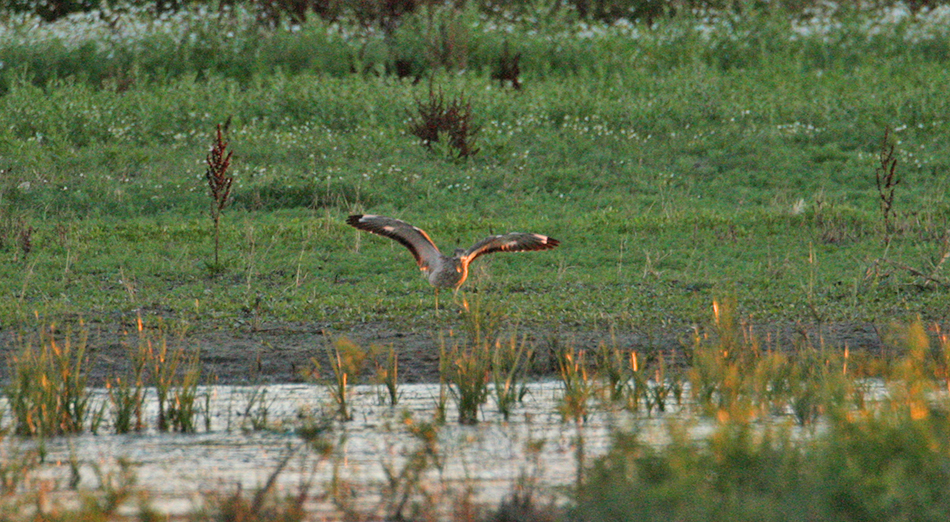
The attached images were the best that I could get given the range to the bird, light conditions and heat haze.


I was initially going to go straight to the southern side of the lagoon to where the birds had been favouring but I decided on a qquick look from the main lagoon viewpoint at the double benches. I gave the wet areas a scan picking out a few Ruff, Black-tailed Godwits and Common Sandpipers and then I picked up something odd on the more distant island, beyond the closest island, and around 300-400 metres away.
It was partially obscured but it looked like a heat hazed Stone Curlew. The more I looked the more I was convinced but I couldn't see the whole bird but then it stuck its head out from behind the vegetation and yep it was a Stone Curlew. This was big news for the SOG area birders with the last and only twitchable one back on 1998 so twenty years ago.
I rapidly composed a message on the local grapevine WhatsApp group and was about to send when I had a pang of doubt and went back to my scope, could it have been a wacky female Mallard sticking its head out and I was fooling myself, I still hadn't seen the bird out in the open. Whilst I looked at the spot the bird was it walked out and in all its Stone Curlewness.
I then sent the WhatsApps message. After about 5mins I was surprised at the lack of local birder respsonse so I looked at the message and realised, for some reason it hadn't been successfully sent so I tried again, still not joy. I tried several more times and still I couldn't get the news out. I performed the 1 o 1 trick of turning phone off and back on again, but still no joy. I could also not get the internet to work or retrieve any emails so it seemed like there was a network issue, of all the times......
I prayed that the phone signal would still be working so I started ringing local birders and thankfully I reached several to get the news out and soon they were on their way.
As the hours ticked by many local birders connected and with some adding it to the local lists.
It was last seen shortly after 9pm when several of us on the south side saw it flew to the fields near the barn and that was what we thought would be that.
All happy local birders.
Two days later it reappeared on the nearest island to the double benches where it spent all day pretty much in the same 10 square feet of vegetation but it did allow more birders to see it. At dusk I was the only birder there watching it as it fed on the muddy edges of the island.
Remarkably it was still present on the 11th August, today, in pretty much the exact same spot, and was twitched by a numbers of birders who needed it for their Essex lists. This species has been remarkably difficult to see in Essex with mostly singles being reported per year but never any twitchable.
A great bird at a great site and one that kick off a spell of good 'local' birds with Great White Egret and then Glossy Ibis being found. It was possible to see all three in a day and making it feel pretty much Mediterranean.
The attached images were the best that I could get given the range to the bird, light conditions and heat haze.



Autumn arrives early
Early August saw an unpresedented arrival of Pied Flycatchers down the east and south coasts of England and the Southend area finally shared in the event. Following the first one in Gunners Park on 2nd August, 10 days earlier than the previous earliest ever local record, two were in Gunners Park by the Serin pond near the main car park. They were generally elusive and mobile but did show well on occasion for the patient observer.
The normal arrival time locally for Pied Flys is from around the 21st August onwards so at the time of this posting this is still 10 days away so I think we could be in for some more to come.
Gunners Park this day also had several Willow Wablers, also early in arriving, with the photograpahed bird along the western side of the park.
Autumn: bring it on


The normal arrival time locally for Pied Flys is from around the 21st August onwards so at the time of this posting this is still 10 days away so I think we could be in for some more to come.
Gunners Park this day also had several Willow Wablers, also early in arriving, with the photograpahed bird along the western side of the park.
Autumn: bring it on


Garden Woody
1st July 2018 saw the first juvenile Great Spotted Woodpecker in the garden for the year.
Since the loss of the Apple Tree, it died a few years back when the ground became water logged, I've had far fewer sightings in the garden. The Apple Tree continues to bring in a few woodpeckers every now and then as several of its larger branches and mid trunk and used as woodpecker and feeding posts around the garden; great for insects as well.


Since the loss of the Apple Tree, it died a few years back when the ground became water logged, I've had far fewer sightings in the garden. The Apple Tree continues to bring in a few woodpeckers every now and then as several of its larger branches and mid trunk and used as woodpecker and feeding posts around the garden; great for insects as well.

Subscribe to:
Posts (Atom)